


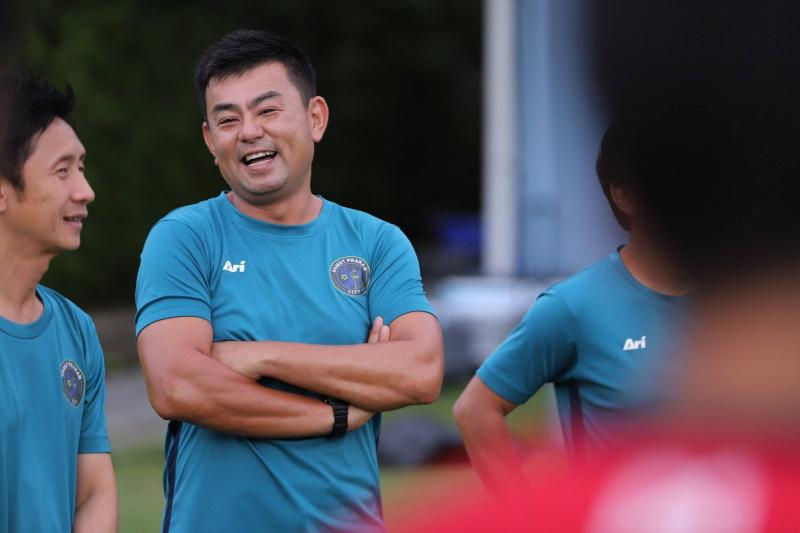
How does it feel to be a head coach?
With his prior experience coming as a youth coach and sporting director, sitting in the hot seat and being responsible for the day-to-day results of the first team could be a daunting prospect. However, Murayama’s approach to management has mitigated these differences and has allowed him to adapt very well to this new role.
“First of all, it is fun,” Murayama admits. “I feel like this job is the continuation of my previous roles.” He goes on to add that he has confidence in his skills based on his previous work experience, which has prepared him sufficiently for this job.
The major added dimension of this job is dealing with pressure – from the media, from fans, and from the board, especially after a hard run. However, the Japanese coach has been coping well and is unfazed by this aspect of the job.
“Due to the language barrier, I honestly don’t know what goes on in the Thai Media, and how they portray me as. The only pressure I feel is about my communication with the players themselves. The pressure is to get the best out of them in every training session. There is no external pressure. As long as you work to your own philosophy, and follow through with your own work process, the result is likely to go your way. This is what I focus on”
How do you improve young players?
Unlike their Premier League namesake, Samut Prakan City’s success has been built without a major investment in the playing squad. Instead, various players have pushed themselves well beyond what was expected of them, moulded into a functioning unit by a coach understandably obsessed with youth development.
The most remarkable success stories of Murayama’s man-management have surely been Picha Autra and Jaroensak Wonggorn. Both sparingly used attacking players last year at Pattaya United, they have been turned into wing-backs with both defensive ability and attacking prowess, covering the flanks as a vital cog in Samut Prakan’s system.
“We set the players small goals, and once they achieve those small goals and targets, they start to piece things together and follow the plan better. Take, for example, Jaroensak. Before, he only played a couple of games. But then, we played a friendly match against Kasetsart. Before bringing him on, I said to him that he is a quick player, and he doesn’t need to do so many tricks. Just use your speed, get to the by-line, and put in a quick cross. That’s it. He followed through with the advice, and he racked up a few assists in that game. Since then, he’s become a key part of the Samut Prakan City team.”
“The other wingback, Picha Autra, was previously someone who never offered any defensive cover. But now, he helps out a lot in defense. He has to sprint up and down 105m over the course of the game, because our three central defenders can’t completely take over of the defending on their own. Most teams in the Thai League play with a front three, so we can’t end up with a 3-vs-3 situation most of the time. So I asked Picha, are you fine with leaving your friends on 3-vs-3 situations against the opponents? His response was to say that it was not ok, so from then on, there was no need for any further instructions. Picha knows why he must sprint up and down to help his teammates back in defense.”
“We let a lot of young players train with the first team, and we let them play in cup games. They might lose the game, but the players can know the pace of the first team is and they know what to expect at an early age. [This lets them know] what they need to do to improve in the future.”