


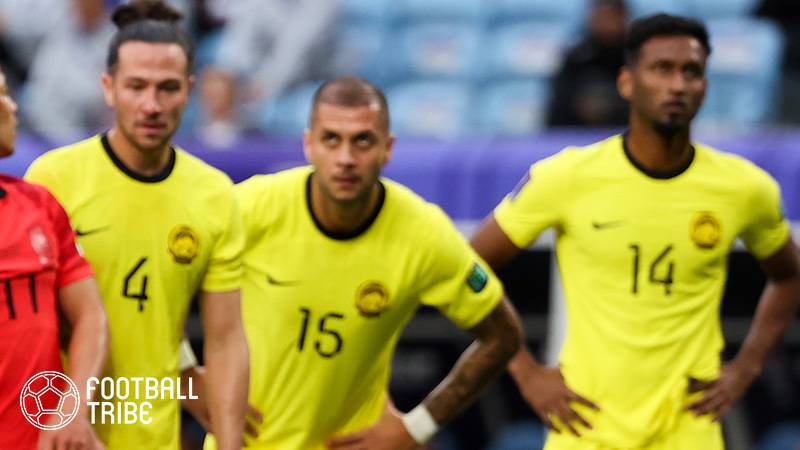
Just hours before their crucial 2027 AFC Asian Cup qualifying clash against regional rivals Vietnam, Malaysia received a timely boost. FIFA granted approval for five newly-naturalized players to feature for Harimau Malaya, a decision that immediately paid dividends as the hosts steamrolled to a 4-0 win at the Bukit Jalil National Stadium in Kuala Lumpur.
In the days leading up to the match, Malaysia unveiled the surprise inclusion of five foreign-born players—all hailing from Spain and South America. These were Alavés defender Facundo Graces (Spain), Sabah FK’s Jon Irazabal (Spain), Vélez Sarsfield striker Imanol Machuca (Argentina), İstanbul Başakşehir forward João Figueiredo (Brazil), and América de Cali danger man Rodrigo Holgado (Argentina).
The quintet joined an already diverse group of naturalized players under head coach Peter Cklamovski, including Héctor Hevel, Paulo Josué, Endrick dos Santos, Romel Morales, Nooa Laine, Stuart Wilkin, La’Vere Corbin-Ong, Dion Cools, Gabriel Palmero, and Matthew Davies.
While several of these players—such as Laine, Wilkin, Davies, and Cools—were eligible through Malaysian ancestry or long-term residency, the eligibility pathway for the latest batch of naturalized players remains opaque. The Football Association of Malaysia (FAM) has yet to publicly clarify the criteria used for Facundo, Jon, Imanol, João, and Rodrigo, raising eyebrows across Southeast Asia.
The lack of transparency fueled concern among fans and pundits alike. Prominent Malaysian football lawyer Zhafri Aminurrashid warned that the influx of new players could attract a FIFA investigation, while Indonesian analyst Akmal Maharli controversially likened the situation to “human trafficking,” arguing that the players had no authentic link to Malaysia. Vietnamese media outlets such as Soha.vn and Lao Động even drew comparisons to the 2017 FIFA sanctions on Timor-Leste, who were found guilty of fielding Brazilian players naturalized through falsified documents.
Despite the storm of skepticism, the FAM defused the situation by announcing just hours before kickoff that FIFA had officially approved all relevant documentation, clearing the five new players to participate.
On the pitch, their impact was immediate. Goals from João, Rodrigo, Corbin-Ong, and team captain Cools dismantled Vietnam, but it was Arif Aiman—one of only two fully homegrown Malaysians in the starting eleven alongside goalkeeper Syihan Hazmi—who truly stole the show. Already regarded as the nation’s top talent, Arif was at the heart of everything positive for Malaysia, registering two assists and tormenting the Vietnamese defense with his pace, movement, and vision.
While the legal and ethical questions surrounding Malaysia’s aggressive naturalization policy remain unresolved, what is clear is the on-field transformation of Harimau Malaya under Cklamovski. With FIFA’s blessing and a bolstered squad blending local gems like Arif Aiman with imported experience, Malaysia now looks well-equipped to mount a serious challenge for Asian Cup qualification—and perhaps ignite a broader debate on national identity and naturalization in Southeast Asian football.