

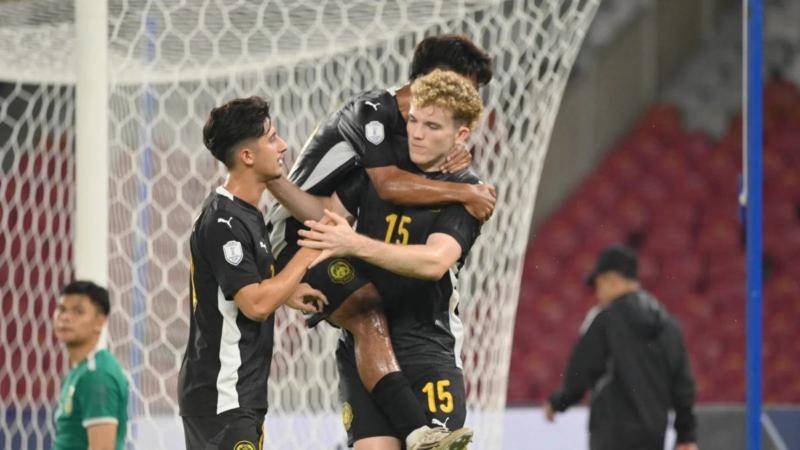
The second matchday in Group A of the ASEAN U-23 Mandiri Cup™ 2025 saw Malaysia come roaring back into the tournament with a devastating attacking display against Brunei, while hosts Indonesia were made to sweat for a narrow win over a well-organized Philippines side. Both games at Jakarta’s Gelora Bung Karno Stadium offered tactical contrasts that highlighted the diversity of approaches at this year’s competition.
🇲🇾 Malaysia 7–1 Brunei: High-Press and Positional Play Tear Apart Brunei
Nafuzi Zain’s Malaysia bounced back from their opening-day disappointment in emphatic fashion, dismantling Brunei with a 7-1 rout that was as much a tactical statement as a scoreline.
Malaysia came out with aggressive intent, deploying a 4-2-3-1 system that morphed into a 3-4-3 in possession. The use of twin pivot midfielders allowed Danish Syamer and Haqimi Rosli to dictate tempo and launch vertical passes between Brunei’s defensive lines. Within four minutes, Malaysia were 2-0 up—Syamer heading home a cross, followed by a forced own goal after intense pressing on the left.
Zain’s side pressed high and crowded the half-spaces, forcing Brunei to play long and inaccurate balls from the back. Haqimi Azim Rosli thrived in the inside channel, scoring twice and assisting once. Haykal Danish and substitute Fergus Tierney made intelligent diagonal runs to stretch Brunei’s back four, who never recovered their shape.
Brunei, meanwhile, looked overwhelmed in midfield. Their 4-4-2 block collapsed under pressure, leaving their full-backs exposed and central defenders outnumbered. Though Haziq Naqiuddin netted a consolation goal—their first of the tournament—Aminuddin Jumat’s men were tactically outmatched from start to finish.
🇮🇩 Indonesia 1–0 Philippines: Darwis’ Throw, Rosquillo’s Misery, and a Midfield Tug-of-War
Indonesia may have picked up all three points against the Philippines, but it was anything but routine. The match was a tight tactical duel, decided by a solitary own goal in the 23rd minute after a long throw-in by Robby Darwis caused confusion and Filipino defender Jaime Rosquillo inadvertently nodded past his own keeper.

Garuda Muda set up in a dynamic 4-3-3, with deep-lying playmaker Arkhan Kaka often dropping between the centre-backs to initiate build-up. However, the Philippines countered effectively with a compact 4-5-1 shape, squeezing central spaces and denying Indonesia their usual rhythm.
Nico Guimarães was outstanding between the sticks for the Philippines, making several point-blank saves and organizing his back line with maturity. Head coach Garrath McPherson clearly instructed his midfielders to break up play early and frustrate Indonesia’s midfield triangles, and for large parts, it worked.
Indonesia’s wingers were forced to come inside due to limited space out wide—something the Philippines anticipated well. However, it was the long throw—often used as a last-resort weapon—that ultimately broke their resistance. Beyond that moment, Indonesia struggled to break down the low block, raising questions about their adaptability in tighter matches.
With two wins in two, Indonesia sit atop Group A and need just a draw against Malaysia to progress. The Philippines, with three points, now face a must-win clash against Brunei—and hope other results fall in their favor.
Tactical Takeaways
-
🇲🇾 Malaysia’s positional fluidity and pressing game exposed Brunei’s defensive flaws.
-
🇧🇳 Brunei lacked compactness and failed to adapt under pressure.
-
🇮🇩 Indonesia’s wing play was stifled, and their reliance on set pieces may be a concern moving forward.
-
🇵🇭 Philippines showed impressive defensive shape and a well-drilled low block—just short of reward.