

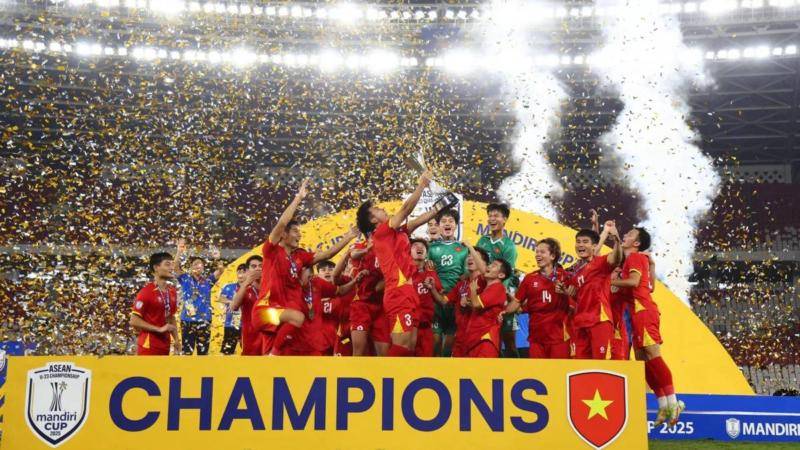
When Vietnam lifted the ASEAN U-23 Mandiri Cup, it wasn’t just a regional triumph—it was a loud, deliberate statement. A statement that said: you don’t need to rely on naturalized players to play smart, cohesive, winning football. Vietnam’s victory, achieved with a squad made up entirely of homegrown talent, offers critical tactical and developmental lessons for South Asian footballing nations such as India, Bangladesh, Nepal, and Sri Lanka.
🇻🇳 The Tactical Identity of Vietnam’s U23 Side
Vietnam didn’t just win the tournament—they controlled games tactically, showing maturity far beyond their age group. Under coach Hoang Anh Tuan, their setup had three key hallmarks:
1. Structured 4-2-3-1 / 4-1-4-1 Shape in and out of Possession
Vietnam’s tactical flexibility was on full display throughout the tournament:
-
In Possession: They transitioned to a 4-2-3-1 with intelligent use of double pivots in midfield, ensuring control in central areas.
-
Out of Possession: They reverted to a more compact 4-1-4-1, denying vertical lanes and making it extremely difficult for opponents to penetrate through the middle.
This structure ensured defensive solidity and allowed them to build from the back with composure, something rare at the U23 level in Southeast Asia.
2. Pressing with Intelligence, Not Just Energy
Vietnam didn’t press blindly. Their press was:
-
Situational – pressing higher when the opponent’s backline lacked composure.
-
Zonal Triggers – pressing in specific zones near the touchline to trap opponents.
-
Compact – lines remained close together, ensuring midfielders could support the press or recover easily if bypassed.
This shows a level of tactical coaching and player IQ that South Asian teams must strive to match.
3. Technical Players with Tactical Discipline
Rather than relying on imported physicality or experienced dual-nationals, Vietnam placed trust in technically developed, tactically educated domestic players:
-
Central midfielders showed positional awareness, tempo control, and the ability to play vertically.
-
Wingers tracked back and doubled up defensively when needed—traits often lacking in flashy but undisciplined South Asian talents.
-
The centre-backs were calm in possession and rarely forced long balls unless tactically necessary.
This level of tactical discipline, ingrained from youth level, was the foundation of their success.
🔍 Lessons for South Asian Football
Vietnam’s success offers a mirror to South Asia—a region rich in football culture but often stagnant in developmental thinking.
1. Youth Development Over Naturalization
South Asian federations, especially India, have flirted with the shortcut of naturalizing players to raise the quality of the national team. But Vietnam’s success shows that investing in local youth academies, coaching education, and tactical literacy yields more sustainable results.
Takeaway: Build talent, don’t buy it.
2. Create a Clear Footballing Identity
Vietnam plays with a clear identity: structured, disciplined, and technically sound. South Asian teams, by contrast, often lack a tactical compass. Frequent changes in coaching philosophy and player selection disrupt the development of a national playing style.
Takeaway: Define a national footballing DNA and build from U16 upwards.
3. Tactical Education at Grassroots
Vietnam’s U23 team reflects years of work by the VFF (Vietnam Football Federation) to instill modern tactics at the grassroots. Players are not just athletic or passionate—they’re intelligent decision-makers on the pitch.
Takeaway: Coaching licenses and tactical education must be democratized and modernized in South Asia.
⚽ Vietnam’s Win: A Wake-up Call, Not Just a Celebration
Vietnam’s U23 Mandiri Cup win is not an isolated achievement. It’s the result of a decade-long systemic approach: consistent coaching, trust in homegrown talent, and the creation of a national playing philosophy. For South Asia, this should be an alarm bell.
There is talent across India, Nepal, Bangladesh, and Sri Lanka. But talent without structure, without coaching, and without tactical identity is just raw potential. Vietnam has shown what happens when that potential is honed, organized, and trusted.
🇮🇳 Final Word for India and South Asia
India’s U23s often look tactically naïve, with heavy reliance on individual brilliance or physically superior dual nationals. If India truly wants to become a footballing nation of repute, the model isn’t in Europe—it’s right here in Southeast Asia, in Vietnam.
Vietnam’s win is a tactical and developmental triumph, not just a footballing one. South Asia must pay attention—before the gap becomes a chasm.