

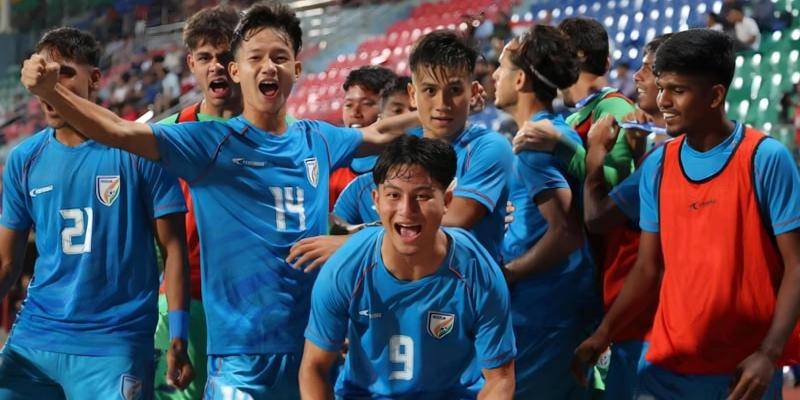
Under a sky that turned from overcast to pouring, India’s U-19 side delivered a tactical masterclass at the Golden Jubilee Stadium on Friday, dismantling the Maldives 3–0 in the semifinal of the SAFF U-19 Championship. The victory not only preserved India’s perfect defensive record in the tournament but also showcased a growing maturity in their in-game management and attacking fluidity.
While the scoreline reflects India’s superiority, the match told a more layered story — one defined by shape discipline, effective use of width, and superior pressing structure.
Control from the First Whistle: India’s Intent in Possession
From kick-off, India established a high tempo, with head coach Shanmugam Venkatesh deploying a dynamic 4-3-3 that morphed into a 3-2-5 during attacking phases. Full-backs overlapped aggressively, allowing wingers to tuck in and create overloads in the half-spaces.
The first goal, arriving in the 14th minute, was a byproduct of this structure. A short corner routine pulled Maldivian defenders out of position, and Prashant Jajo floated in a precise ball. Danny Meitei, lurking just outside the six-yard box, executed a technically sound volley — a testament to his sharp movement and India’s set-piece preparation.
Engine Room Brilliance: Jajo, Meitei, and Dodum Orchestrate
The midfield triangle of Shami, Jajo, and Prashan provided both verticality and security. Jajo, playing as a left-sided attacking midfielder, frequently dropped into wider zones to create mismatches. His assist for the second goal — a deft scoop over the high line — showcased his vision under pressure.
Meitei’s spatial intelligence allowed him to draw markers out, opening up a central lane for Dodum, who ghosted in to finish with composure in the 21st minute. The second goal epitomized India’s ability to exploit space through coordinated off-ball runs — a feature of their play throughout the tournament.
Weathering the Storm — Literally and Tactically
As the heavens opened in the second half, so did the complexity of the match. Rain made quick passing and ball control a challenge, yet India adapted seamlessly by switching to more direct play. Their defensive shape narrowed, limiting central spaces and forcing the Maldives wide — a zone they lacked the quality to consistently threaten from.
When Maldives did manage to get shots away, India’s goalkeeper Suraj Singh Aheibam responded with assured handling. Suraj’s command of the box and communication were crucial in maintaining India’s shape as they transitioned into a more conservative 4-1-4-1 mid-block late in the match.
The Final Blow: A Reflection of Confidence and Game Awareness
In the 66th minute, with India firmly in control, Jajo stepped up again. Collecting the ball in a central pocket, he unleashed a low, swerving drive from 25 yards out. Maldivian goalkeeper Xahran Hassan Ziyad misjudged the wet ball’s pace and trajectory, allowing it to slip through — an error under pressure, but also a shot well-placed with intent.
That strike put the tie beyond doubt and highlighted India’s growing tendency to test keepers from range — a strategy likely emphasised during training, given the unpredictable weather.
Defensive Solidity and Tactical Maturity
While the attacking patterns have caught the eye, India’s defensive organisation has quietly laid the foundation for their run to the final. Whether in a pressing 4-3-3 or a deeper 4-1-4-1, India’s backline has communicated, covered, and tackled with impressive coordination. Holding a high line when needed and compressing space between the lines when under pressure, they’ve neutralised threats with discipline rather than desperation.
A Final Against Bangladesh Awaits
With Bangladesh edging past Nepal 2–1 in the earlier semifinal, India will face a familiar regional rival in the final. Expect tactical tweaks, but India’s core principles — structured pressing, intelligent off-ball movement, and flexible attacking width — will remain central.
As defending champions, India now stand not only as favourites but as the most tactically complete side in the tournament.
Tactical Takeaways:
-
Formation Fluidity: India’s 4-3-3 shape adapted smartly to match situations, particularly in transition.
-
Set-Piece Threat: Structured routines continue to pay dividends, with two goals originating from dead-ball scenarios.
-
Midfield Balance: The blend of flair (Jajo), control (Prashan), and aggression (Shami) is proving pivotal.
-
Adaptability: Seamless transition from short-passing buildup to direct play in wet conditions demonstrated composure and game intelligence.
-
🇮🇳 India 3–0 Maldives 🇲🇻
SAFF U-19 Championship 2025 — Semifinal
📍 Golden Jubilee Stadium, Itanagar
🗓️ May 16, 2025
🧠 Tactical Snapshot
-
🔄 Formation: 4-3-3 (Attacking), shifting to 3-2-5 in possession
-
🧱 Defensive Shape: Compact 4-1-4-1 mid-block
-
🌧️ Adaptability: Shifted to direct play due to heavy rain
-
🎯 Key Strategy: Use of width, overloads in half-spaces, and pressing traps
⚽ Goals Breakdown
Minute Scorer Assist Description 14’ Danny Meitei Prashant Jajo Volley off a corner – clean finish, Meitei’s 5th of the tournament 21’ Omang Dodum Meitei (via Jajo build-up) Brilliant scoop pass, one-touch layoff, calm close-range finish 66’ Prashant Jajo — Long-range strike; GK error in slippery conditions
🧩 Key Players
-
🎩 Prashant Jajo: 1 goal, 1 assist, constant creative outlet
-
⚡ Danny Meitei: Scored and assisted; intelligent movement between lines
-
🧤 Suraj Singh Aheibam: Multiple saves; led a confident backline
🔍 Stat Highlights
-
🟦 Possession: India 61%
-
🎯 Shots on Target: India 8 / Maldives 2
-
🧱 Clean Sheets: 3 in 3 games
-
🚫 Goals Conceded: 0
-
👟 Passing Accuracy: 86%
-